
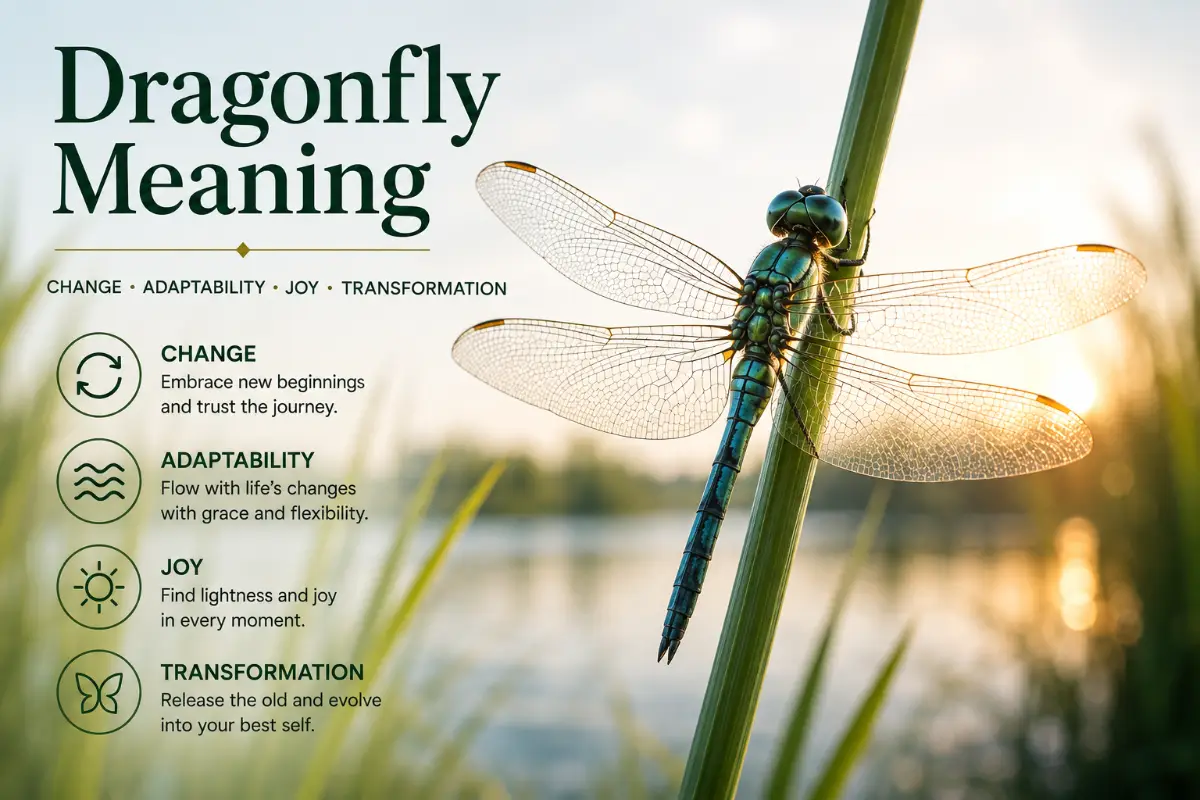
The Dragonfly Meaning is often connected with change, transformation, and the freedom to live fully in the present moment. Across cultures, the dragonfly has become a powerful symbol of self realization, adaptability, and seeing beyond illusion.
Its life cycle makes this symbolism even more meaningful. A dragonfly spends years underwater as a nymph before emerging into its brief adult life, representing growth, letting go of the past, and starting over. For many people, seeing a dragonfly can serve as a gentle reminder to embrace change, trust personal growth, and appreciate the moment you’re in.
Meaning at a Glance
| Category | Details |
|---|---|
| Part of speech | Noun |
| Definition | A symbol of transformation, change, adaptability, and personal growth |
| Language of origin | English word from Middle English draguene fle, symbolic meaning shaped by many world cultures |
| Context of use | Spiritual and wellness writing, tattoo art, nature symbolism, grief and loss conversations, everyday talk about change |
| Pronunciation | DRAG uhn fly |
What Does Dragonfly Mean?
At the most basic level, a dragonfly is an insect. It has a long thin body, four transparent wings, and huge eyes that let it see almost everything around it at once. But when people ask what a dragonfly means, they are rarely asking about biology. They are asking about the symbol.
For centuries, people watching dragonflies noticed something odd about them. A dragonfly spends most of its life underwater as a nymph, sometimes for years, hidden and unseen. Then one day it climbs out of the water, sheds its old skin, and becomes something completely different. It grows wings, it takes to the air. It lives that new winged life for only a few weeks or months before it dies. That dramatic before and after story is why the dragonfly became such a strong symbol of transformation.
So when someone says a dragonfly appeared to them at a meaningful moment, or asks what it means to keep seeing dragonflies, they are usually pointing at one core idea. Something in their life is changing, or needs to change, and the old version of themselves is being asked to let go so a new one can take shape.
Deeper Meaning and Significance
Primary Meaning
The primary meaning tied to a dragonfly is transformation. This is not a small or passing kind of change. It is the deep kind, the sort that reshapes who a person is on the inside.
Think about what the dragonfly actually goes through. As a nymph, it lives underwater, breathing through gills, hunting small prey, growing slowly in the dark for months or even years depending on the species. Then it goes through a process called metamorphosis. It climbs onto a plant stem above the waterline, its skin splits open, and an entirely new creature emerges. Its body changes shape. It grows the wings and the compound eyes that let it fly and hunt in open air. The insect that flies away is barely recognizable as the same animal that crawled out of the pond.
People have mapped their own life changes onto that story for a long time. A breakup that forces someone to rebuild their sense of self. A career change after years in a job that no longer fit. Recovery from illness or grief that leaves a person different than they were before. In all of these cases, the dragonfly becomes shorthand for this idea, that painful change can lead somewhere better, and that the old shell has to come off before the new self can fly.
Secondary Meaning
The secondary meaning centers on clarity, self realization, and seeing through illusion. A dragonfly has enormous compound eyes, made up of thousands of individual lenses, giving it nearly 360 degree vision. It misses almost nothing happening around it.
Because of this, many spiritual traditions connect the dragonfly to clear sight, both literal and emotional. Seeing a dragonfly is often read as a nudge to look at a situation honestly, without the stories or excuses a person might be telling themselves. It is associated with cutting through confusion and getting to the truth of a matter.
This meaning also connects to lightness and joy. A dragonfly moves quickly, changes direction in an instant, and seems to dance over water on a summer afternoon. That light, quick movement has made it a symbol of living in the moment rather than staying stuck in the past or anxious about the future. Where the primary meaning is about the big picture of transformation, the secondary meaning is about the day to day practice of staying present and seeing clearly while that transformation happens.
Origin and Symbolic History
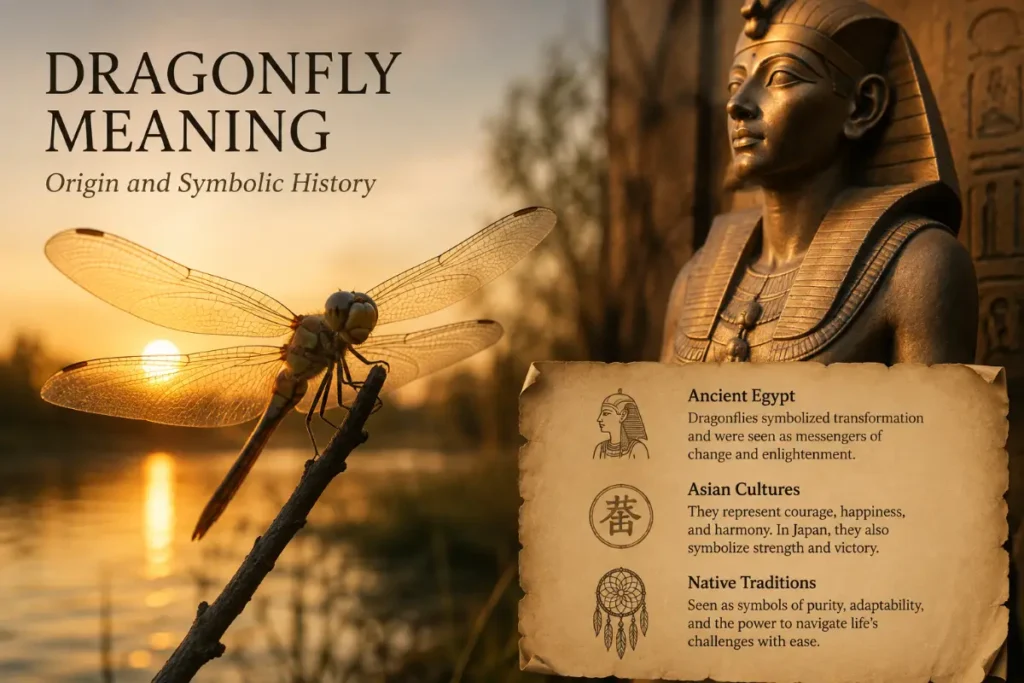
The English word dragonfly comes from Middle English, likely a folk description of the insect’s fierce, almost dragon like hunting style in the air. Older European folklore was not always kind to the dragonfly. In parts of medieval Europe it picked up nicknames like devil’s needle or horse stinger, tied to superstitions that it could sew shut the mouths of scolds or sting horses, none of which is true. The insect is harmless to people and does not sting.
Move outside of Europe and the symbolism turns far more positive, and this is where most of the meaning people search for today actually comes from.
In several Native American traditions, including Zuni and Hopi cultures, the dragonfly is tied to water, purity, and renewal, since it is so closely linked to ponds, streams, and wetlands. It has also been used as a symbol of speed and activity, and in some Pueblo traditions it appears in pottery and art as a sign of transformation and swift, effective action.
In Japan, the dragonfly holds a particularly strong and long standing place in culture. It has historically been seen as a symbol of strength, courage, and victory, sometimes called the victory insect, because of the way it moves forward in flight and rarely retreats. Samurai warriors used dragonfly imagery on their armor and weapons for exactly this reason. Japan has also been referred to poetically as the Dragonfly Islands, and the insect appears often in traditional Japanese poetry and art as a symbol of the changing seasons, especially autumn.
In China, dragonflies have often been associated with prosperity, harmony, and good luck, and their appearance near water has long been read as a positive sign.
In Celtic and broader European folk belief, dragonflies were sometimes linked to fairies and the otherworld, seen as messengers moving between the visible world and something beyond it, which is part of why so many people today describe a dragonfly sighting as feeling like a visit or a sign rather than just an ordinary bug landing nearby.
Modern spiritual and wellness writing has pulled all of these threads together into the version of dragonfly symbolism most people encounter today, transformation, clarity, adaptability, and a light hearted reminder to live fully in the present.
Examples in Sentences
Real Life Clarity
- She got a small dragonfly tattoo on her wrist right after finishing chemotherapy, as a personal reminder of how much she had changed.
- A dragonfly landed on the porch railing the morning of the funeral, and her grandmother swore it was a sign that he was at peace.
- The therapist used the dragonfly as an image in their session, asking him to picture leaving his old patterns behind the way a dragonfly leaves its nymph shell.
- My daughter asked what a dragonfly meant after one followed her around the garden for ten minutes, so we looked it up together.
What It Looks Like in Daily Life
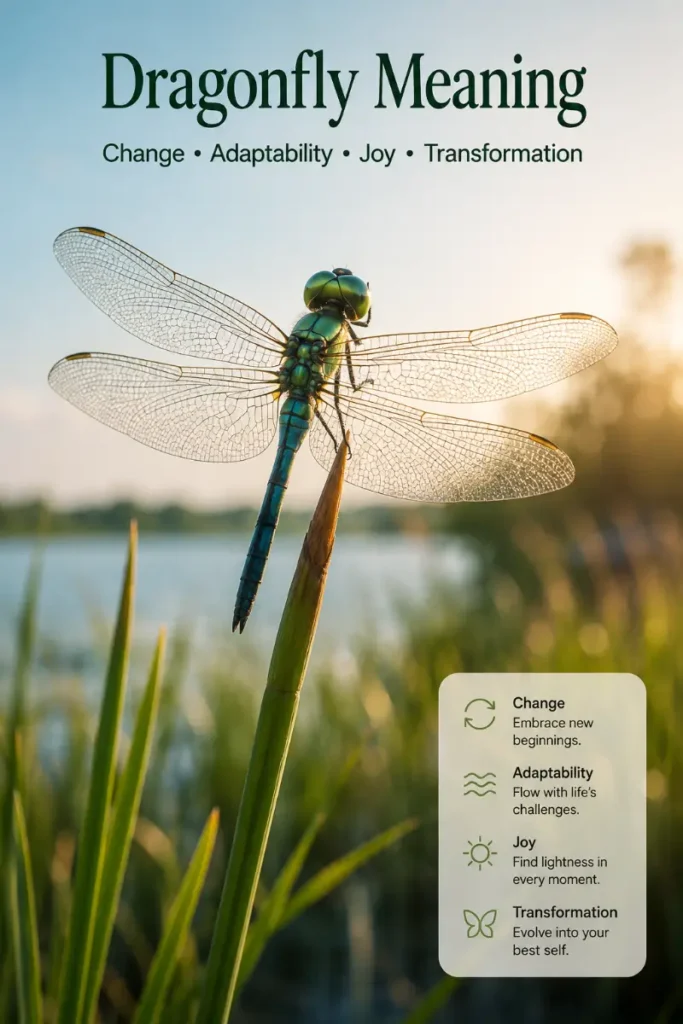
Picture someone sitting by a pond on a hard day, replaying a decision they are not sure they made correctly. A dragonfly hovers close, drifts off, then circles back and lands on a nearby reed. It is such a small moment, over in a few seconds, but it sticks with them. Later that night they look up what a dragonfly flying close to someone might mean, and they read about transformation, about letting go of an old version of yourself. It does not hand them an answer. What it does is give them a quiet, familiar image to hold onto while they sit with the bigger question they are actually working through, which is usually not about the insect at all, but about themselves.
This is the most common way the meaning actually shows up in daily life. Not as a strict rule or a fortune telling device, but as a small, natural moment that gives people permission to reflect on change they are already going through.
Synonyms and Related Terms
- Transformation, the broader concept the dragonfly is most closely tied to.
- Metamorphosis, the biological process the dragonfly physically goes through and the word most directly related to its symbolism.
- Renewal, often used alongside dragonfly symbolism in spiritual and wellness contexts.
- Adaptability, describing the dragonfly’s ability to move easily between water and air, forward and back, and change direction instantly.
- Damselfly, a closely related insect, smaller and more delicate, that shares some of the same symbolism though it is treated as a gentler variation.
- Butterfly, another insect strongly tied to transformation, though butterfly symbolism leans more toward beauty and a single dramatic change, while dragonfly symbolism leans more toward speed, clarity, and repeated adaptation.
Meaning in Different Contexts
Usage in Different Contexts
The meaning of a dragonfly shifts a little depending on where and how it comes up.
In spiritual and New Age contexts, it usually points to personal transformation, self realization, and a call to release something that is holding a person back, whether that is a habit, a relationship, or an old identity.
Dragonfly designs are extremely popular and tend to carry a personal, often deeply meaningful story behind them, most commonly tied to overcoming a hard chapter of life, surviving illness, or marking a major turning point such as sobriety, a divorce, or starting over in a new place in tattoo culture.
In literature and poetry, the dragonfly often shows up as a symbol of the fleeting nature of life itself, since its adult stage is so short compared to the time it spends developing. Writers use it to point at how brief and precious a single season of life can be.
In conversations about grief and loss, a dragonfly sighting is frequently described as a visitation, a small sign from someone who has died, especially when the sighting happens at an unusual or emotionally loaded moment, like a funeral, a birthday, or an anniversary.
In a purely scientific or nature focused context, none of this symbolism applies at all, and the word simply refers to the insect, its behavior, its habitat, and its role as a predator that helps control mosquito populations.
Meaning Across Social Media and Online Culture
In Spiritual and Wellness Content
Search interest in dragonfly meaning tends to rise sharply whenever spiritual and wellness content about it circulates online. Short videos describing what it means when a dragonfly crosses your path, or what it means to keep seeing dragonflies, are common on platforms built around short form video and image sharing. These posts usually repeat the same core themes covered above, transformation, clarity, and a gentle sign to trust a change that is already underway.
Grief support communities online also share dragonfly symbolism often, describing it as a comforting sign from a loved one who has passed. This use is less about strict tradition and more about the comfort the image provides during a hard time.
How People Talk About It When Someone Shares a Dragonfly Sighting
When someone shares that a dragonfly showed up at a meaningful moment for them, most people respond in a warm, supportive way rather than a skeptical one, since the story is usually tied to something personal and emotional.
- That is such a beautiful way to look at it, I am glad it gave you some comfort.
- I love that. Dragonflies are supposed to be a sign of change, maybe that is exactly what you needed right now.
- That gave me chills a little. Whatever it means to you, I am glad it happened.
The point of these replies is not to confirm or deny the symbolism as fact, but to meet the person where they are and let the moment mean what it means to them.
Why People Look This Up
Interest in dragonfly meaning tends to spike around a few recurring situations rather than one single trend. People search it after an unusually close or repeated encounter with a dragonfly that feels different from an ordinary bug sighting. They search it while grieving, hoping to understand a sighting that happened around a funeral or a difficult anniversary. They search it while considering a tattoo, wanting to understand the symbolism before committing to it permanently. And they search it during periods of major personal change, like a new job, a move, a breakup, or recovery from illness, when the idea of transformation already feels close to home.
None of this is really about the insect itself. It is about people looking for language to describe change they are already living through, and finding that the dragonfly gives them a simple, natural image to hang that experience on.
Quick Recap
A dragonfly means transformation, adaptability, and clear sight, built on the real biological story of an insect that spends years underwater before becoming something entirely new for a short, vivid adult life. Different cultures have shaped that basic idea in their own ways, from Japanese symbols of strength and victory to Native American associations with water and renewal to modern spiritual talk of change and letting go. Whether it shows up in a tattoo, a grief support group, or a quiet moment by a pond, the meaning almost always comes back to the same thing, a reminder that change, even the hard kind, can lead somewhere worth flying toward.
FAQs
1. What does a dragonfly symbolize?
A dragonfly commonly symbolizes change, transformation, growth, adaptability, and living in the present moment. It can also represent the courage to let go of the past and embrace a new beginning.
2. What is the spiritual meaning of a dragonfly?
Spiritually, a dragonfly is often linked to self realization, inner growth, clarity, and seeing beyond illusion. Its transformation from an aquatic nymph into an adult dragonfly makes it a powerful symbol of personal change.
3. What does it mean when you keep seeing dragonflies?
Repeatedly seeing dragonflies is often interpreted as a reminder to embrace change, stay present, and trust your personal growth. For some people, it can also symbolize moving forward after a difficult period.
4. What does a dragonfly symbolize in different cultures?
Dragonflies have different meanings across cultures, but common themes include transformation, renewal, adaptability, good fortune, and spiritual awareness. Their connection with water and air also adds to their symbolism of change and freedom.
5. What does a dragonfly mean in love?
In love, a dragonfly can symbolize emotional growth, positive change, freedom, and new beginnings. It may represent letting go of past relationships or experiences and becoming open to a deeper connection.
Conclusion
At its core, a dragonfly means change you can actually see happening. It spends most of its life hidden and slowly growing, then transforms almost overnight into something completely different and much more free. That is why the symbol has stuck with so many cultures for so long, and why people still reach for it today when they are trying to make sense of their own turning points. Whether you are looking at one hovering over a pond, thinking about a tattoo, or simply curious after seeing the word searched online, the meaning underneath it all stays the same, a small, winged reminder that letting go of what you were is often the price of becoming what you are meant to be next.

Nova Ezra is an internet culture researcher and lead editor. With a passion for documenting the rapid evolution of digital language, Nova specializes in decoding viral slang, meme origins, and social media vernacular. Their goal is to bridge the communication gap between generations, providing clear, real-time insights into the phrases shaping today’s online discourse.