
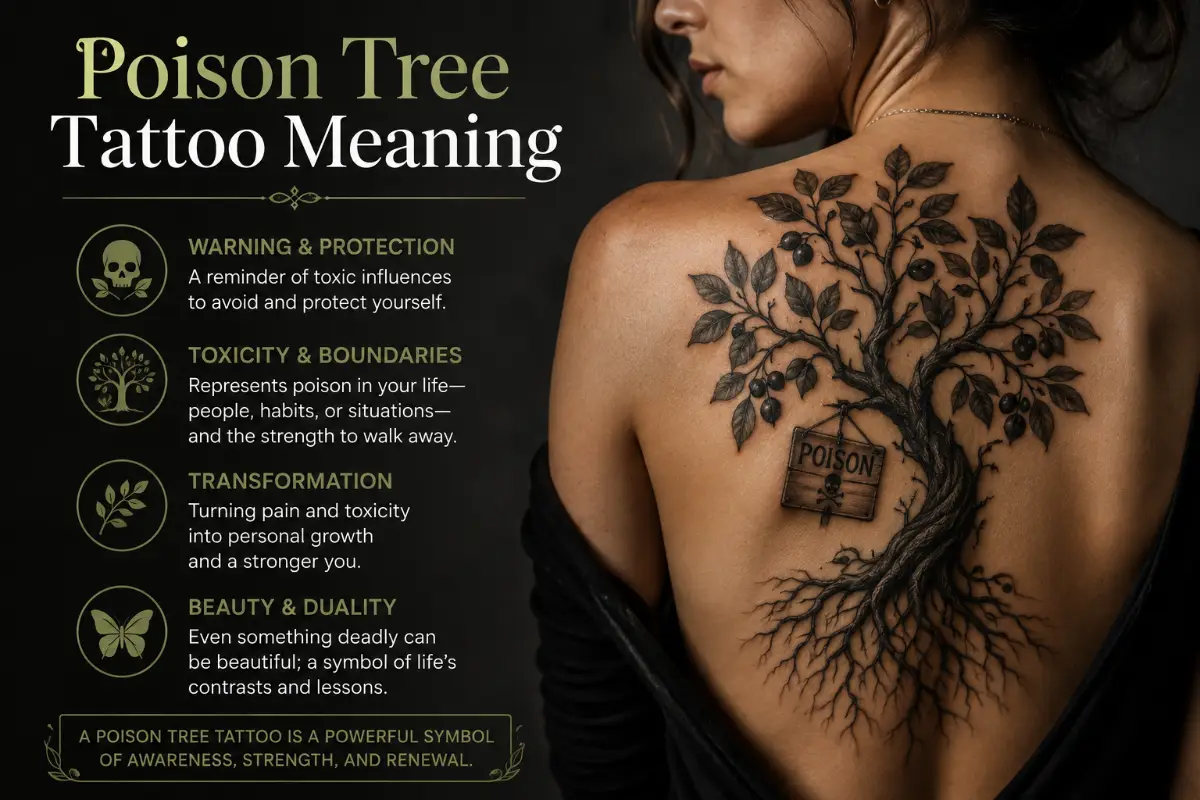
The poison tree tattoo meaning is often linked to hidden anger, resentment, emotional pain, and the consequences of letting difficult feelings grow over time. The imagery is strongly connected to William Blake’s poem A Poison Tree, giving the design a deeper literary meaning.
For some people, the tattoo represents betrayal or a painful experience that left a lasting mark. For others, it symbolizes strength, self awareness, healing, or learning to let go of emotions that once felt impossible to escape.
The meaning can also change with the tattoo’s details. Twisted roots, bare branches, poisonous fruit, flowers, or an apple can each add another layer to the design. Understanding these symbols makes it easier to see why the poison tree has become such a meaningful tattoo choice.
Meaning at a Glance
| Detail | Meaning |
|---|---|
| Part of speech | Noun phrase |
| Definition | A tattoo symbolizing hidden anger, resentment, emotional pain, danger, consequences, or personal transformation |
| Language of origin | English |
| Context of use | Tattoo symbolism, literature, emotional expression, gothic art, social media |
| Pronunciation | POY zən tree ta TOO MEE ning |
The phrase poison tree tattoo meaning refers to the symbolism people attach to a tattoo depicting a poisonous or corrupted tree. It isn’t a slang word with one official definition. Its interpretation depends heavily on the design, the wearer, and the story behind the tattoo.
The strongest literary connection comes from William Blake’s A Poison Tree, published in Songs of Experience in 1794. Blake uses a tree as a metaphor for anger that grows after it is deliberately kept inside.
What Does Poison Tree Tattoo Meaning Mean?
In simple terms, a poison tree tattoo represents emotions that have grown into something harmful, especially anger, resentment, bitterness, or pain that was never properly addressed.
The symbol comes largely from William Blake’s poem A Poison Tree. In the poem, anger toward a friend disappears after it is expressed, while hidden anger toward an enemy grows until it becomes a poisonous tree bearing fruit.
That makes the tattoo more complex than a typical tree design.
A normal tree can symbolize life, family, growth, strength, wisdom, or stability. A poison tree changes the message. Its roots can suggest buried feelings, its branches can represent emotions spreading over time, and its poisonous fruit can represent the consequences of those feelings.
For some people, the tattoo is a reminder of anger they once carried. For others, it represents betrayal, a toxic relationship, survival, or a difficult period they have moved beyond. Contemporary tattoo interpretations also commonly connect the design with healing and self awareness.
So, if someone asks, “What does a poison tree tattoo mean?” the shortest useful answer is:
It usually represents hidden anger or emotional pain that grows over time, along with the consequences of allowing resentment to take root.
Deeper Meaning and Significance
Primary Meaning
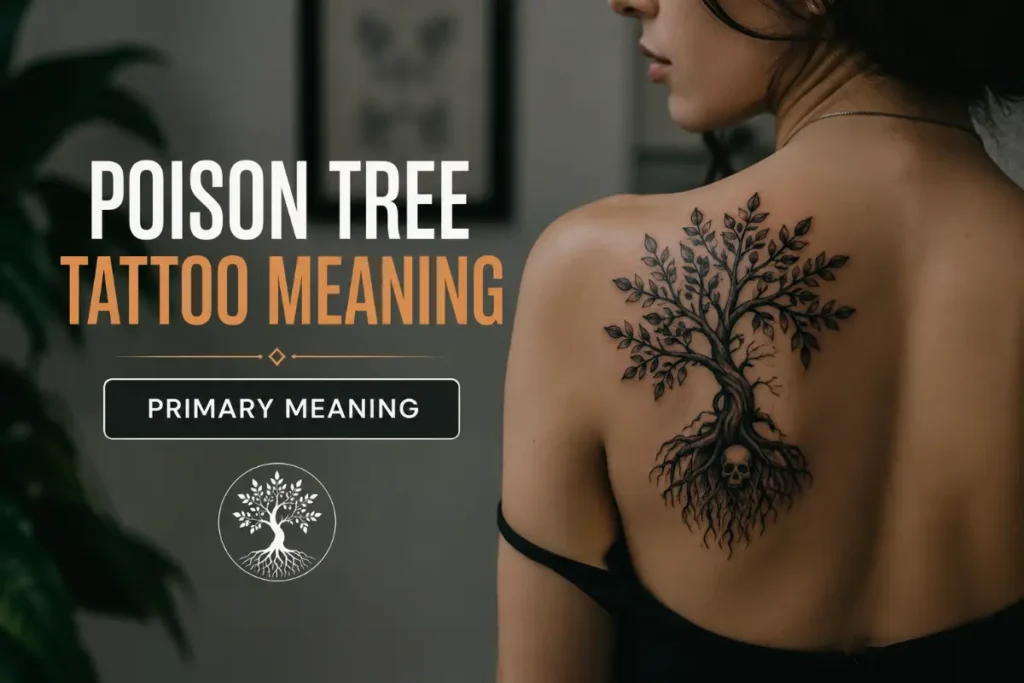
The primary meaning is suppressed anger.
This interpretation comes directly from Blake’s central metaphor. The speaker tells a friend about his anger, and it ends. He keeps his anger toward an enemy secret, and it grows. The tree therefore represents an emotion that has been deliberately fed rather than released.
A tattoo based on this idea can serve as a permanent reminder to deal with difficult emotions before they become destructive.
The roots might symbolize the original hurt. The trunk can represent years of emotional buildup. The branches can show how resentment affects other parts of life. The fruit can represent the eventual consequence.
This is also why the tattoo can have a connection with strength. Strength doesn’t always mean being unaffected by pain. In this context, it can mean recognizing pain, understanding anger, and refusing to let either control your future.
Secondary Meaning
The secondary meanings are broader and more personal.
A poison tree can symbolize:
- Betrayal after trust has been broken.
- Resentment that has remained unresolved.
- Revenge and the consequences that can follow it.
- Toxic relationships that left a lasting emotional mark.
- Emotional survival after a difficult experience.
- Healing after recognizing destructive patterns.
- Self awareness and confronting uncomfortable emotions.
- Transformation from pain into wisdom.
- Protection through stronger boundaries.
- Dark beauty, especially in gothic or alternative tattoo art.
The important point is that the tattoo does not automatically mean the wearer is angry or dangerous. It can just as easily represent someone who has learned what anger can do and wants to remember that lesson.
Recent tattoo discussions and guides repeatedly describe the design as a symbol that can move from hidden anger toward healing and personal growth.
Origin and Etymology
The phrase poison tree tattoo is modern English, but its strongest symbolic source is much older.
William Blake’s poem A Poison Tree was published as part of Songs of Experience in 1794. The poem presents anger as something that can be cultivated. When the speaker openly expresses anger to a friend, it ends. When he hides anger from an enemy, it grows into a tree that eventually produces a deadly apple.
The tree therefore works as an extended metaphor.
The word poison suggests something harmful or destructive. The word tree suggests growth, roots, time, and something that becomes larger after being nourished. Put together, the image suggests harmful feelings that are allowed to grow.
The apple adds another layer. It can suggest temptation, danger, revenge, consequence, or something attractive that hides a harmful result.
Blake’s poem also has associations with the biblical imagery of the Garden of Eden, although a poison tree tattoo is not inherently a Christian or biblical symbol. Its clearest literary foundation remains Blake’s poem.
That distinction matters because people sometimes assume every poison tree tattoo has the same religious meaning. It doesn’t.
Examples in Sentences
Real Life Clarity
Here are some natural examples showing how the phrase can be used:
- “She chose a poison tree tattoo to represent the resentment she finally learned to release.”
- “His poison tree tattoo was inspired by William Blake’s poem.”
- “The roots in her poison tree design represent years of hidden pain.”
- “He sees his poison tree tattoo as a reminder not to let anger grow.”
- “The apple gives her poison tree tattoo a stronger connection to Blake’s poem.”
- “Her design represents survival rather than revenge.”
- “The tattoo has a dark appearance, but its meaning is actually about healing.”
- “He wanted a tree tattoo that represented the complicated side of personal growth.”
Mean in Daily Life
In everyday conversation, someone might say:
“I’m thinking about getting a poison tree tattoo.”
A natural response would be:
“That has a pretty deep meaning. Is yours based on William Blake’s poem?”
Another example:
“She said her tattoo represents everything she learned from a toxic relationship.”
In that situation, the poison tree is being used as a personal metaphor. The person isn’t necessarily saying that they are still angry. They may be showing that the experience changed them.
This is one reason the design has become appealing to people who want tattoos that tell a story rather than simply represent an attractive image.
Synonyms and Related Terms
There isn’t a perfect synonym for poison tree tattoo meaning, because the phrase describes a specific symbolic concept.
Related terms include:
- Suppressed anger
Feelings of anger that are hidden instead of openly addressed. - Hidden resentment
Negative feelings that remain beneath the surface. - Toxic growth
Growth that develops from unhealthy circumstances. - Emotional consequence
The result of allowing difficult feelings to remain unresolved. - Betrayal symbolism
A visual representation of broken trust or emotional hurt. - Forbidden fruit symbolism
Imagery associated with temptation, danger, and consequences. - Dark tree symbolism
Tree imagery connected with loss, pain, mystery, or inner conflict. - Emotional transformation
The process of turning a painful experience into understanding or personal growth. - Healing symbolism
A reminder of recovery and moving beyond destructive emotions. - Literary tattoo symbolism
Body art inspired by a poem, book, character, or literary idea.
Meaning in Different Contexts
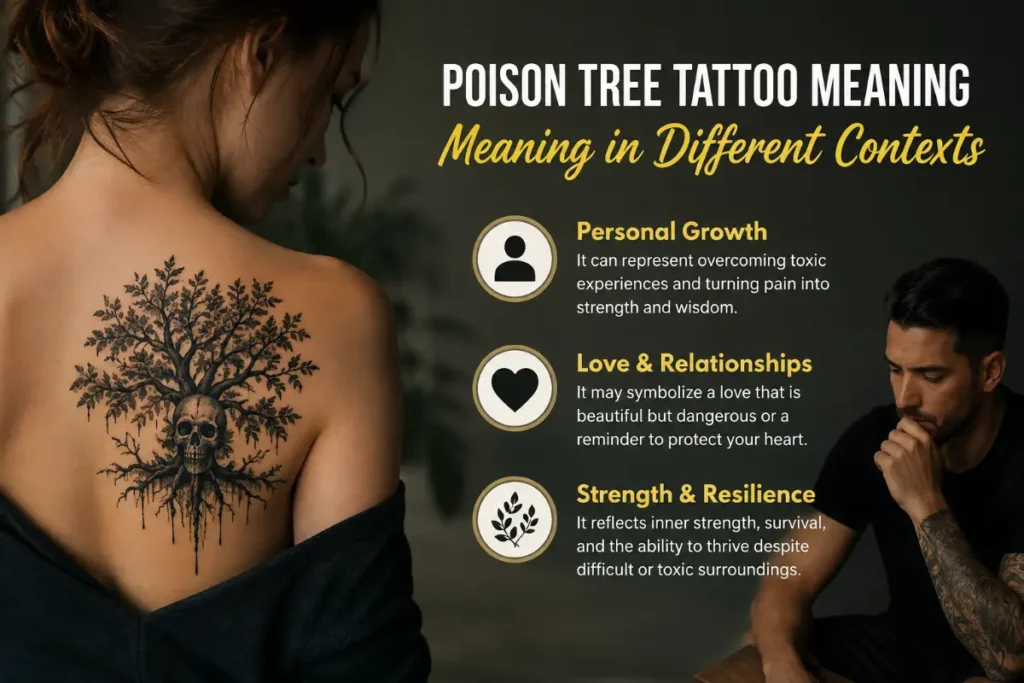
The symbolism can change significantly depending on the tattoo design and the reason someone chose it.
A black tree with dead branches may emphasize anger, grief, or emotional darkness. A tree with flowers or fresh leaves can shift the message toward healing and renewal.
An apple can make the Blake connection easier to recognize. Twisted roots can emphasize buried pain. Thorns can suggest protection or boundaries. A broken branch can represent loss or an ending.
That flexibility is one of the biggest reasons the design works so well as personal body art.
Usage in Different Contexts
In literature, the symbol is strongly connected with Blake’s A Poison Tree and the destructive growth of hidden anger.
In tattoo culture, it can represent resentment, betrayal, emotional pain, survival, healing, or a personal warning.
For a woman, a poison tree tattoo may be chosen as a symbol of emotional independence, surviving betrayal, reclaiming anger, or building stronger boundaries. These interpretations are personal rather than gender specific.
For men, the design may be interpreted as quiet emotional struggle, self control, resilience, or learning to confront anger rather than suppress it. The symbolism itself isn’t exclusive to men.
For someone searching for poison tree tattoo meaning in simple terms, the clearest explanation is: pain or anger that grows when it is kept inside.
For someone searching for poison tree tattoo meaning strength, the strongest interpretation is emotional resilience. The tattoo can represent surviving something painful and becoming more self aware because of it.
Meaning Across Social Media Platforms
On social media, tattoo meanings are often simplified into short captions, aesthetic posts, comments, and personal stories.
Instagram and TikTok users may focus on the visual side of the tattoo, especially dark botanical imagery, twisted branches, poisonous fruit, or gothic styling. Pinterest style content often emphasizes the design itself, while discussion based platforms can focus more heavily on personal symbolism.
The phrase can also appear in searches on X and Reddit when people are trying to understand what a tattoo represents.
It’s important not to treat every social media explanation as an official definition. A tattoo symbol has no universal dictionary meaning. The wearer’s explanation matters most.
Searches for poison tree tattoo meaning Reddit can therefore produce personal interpretations rather than one authoritative answer. The same applies to searches for poison tree tattoo meaning Urban Dictionary. Urban Dictionary is built around user submitted definitions, so it shouldn’t be treated as the historical authority for Blake’s symbolism.
Meaning in Online Dating & Social Conversations
A poison tree tattoo can sometimes become a conversation starter in dating or social settings.
If someone has one visible on their arm, shoulder, chest, or back, another person might ask:
“Does your tattoo have a story behind it?”
The answer could be literary, personal, aesthetic, or completely unrelated to Blake.
Someone might have chosen it because they love poetry. Another person might associate it with betrayal. Someone else might simply like dark botanical art.
This is why it is risky to assume a person’s relationship history from the tattoo alone.
A poison tree tattoo doesn’t automatically mean someone has experienced a toxic relationship, wants revenge, or carries unresolved anger.
How to Reply When Someone Uses Poison Tree Tattoo Meaning
If someone says “What does poison tree tattoo meaning mean?”, a simple answer is:
“It usually symbolizes hidden anger, resentment, emotional pain, or the consequences of letting negative feelings grow. It’s often connected to William Blake’s poem A Poison Tree.”
If someone says they have the tattoo, you can ask:
“Is yours inspired by William Blake, or does the tree have a personal meaning for you?”
If someone says the tattoo represents their past, a thoughtful response is:
“That sounds meaningful. I like how the design can represent both what happened and what you learned from it.”
That keeps the conversation open without assuming the person’s story.
Why This Word Is Trending in 2026
Technically, poison tree tattoo meaning isn’t a single word. It’s a search phrase describing a tattoo symbol. Its growing visibility in 2026 appears to be connected to the combination of literary tattoos, dark botanical aesthetics, emotional symbolism, and social media interest in tattoo meanings.
Multiple tattoo publications have published dedicated poison tree guides during 2026, covering themes such as suppressed anger, betrayal, healing, personal transformation, and William Blake’s poem.
The symbol also fits a broader interest in tattoos that carry a story. A simple tree can represent growth, but a poison tree introduces conflict. It can show that growth isn’t always positive and that experiences can leave lasting emotional roots.
Another reason people may search for the meaning before getting the tattoo is its ambiguity. A dark tree can look beautiful while carrying a serious message. Someone considering the design may want to know exactly what other people could assume when they see it.
Still, there isn’t a single authoritative 2026 statistic proving that poison tree tattoos are universally trending. The safer conclusion is that the topic has gained noticeable online publishing and search interest during 2026, particularly around symbolism and design interpretation.
Pros and Cons of Using this Term
The phrase poison tree tattoo meaning is useful when you’re researching the symbolism behind this specific tattoo, but it has some limitations.
Pros
- It clearly identifies the subject.
Readers immediately know the discussion is about the meaning behind a tattoo. - It connects literature with visual symbolism.
The Blake connection gives the design a deeper cultural background. - It covers several emotional interpretations.
The tattoo can represent anger, resentment, betrayal, strength, healing, or transformation. - It works for personal storytelling.
A tattoo can represent a specific experience without requiring the wearer to explain every detail. - It supports different design choices.
Roots, apples, branches, flowers, and other details can change the emphasis.
Cons
- There is no single universal meaning.
Different people can choose the same design for completely different reasons. - The dark imagery can be misunderstood.
Some people may assume the tattoo represents revenge or anger. - The Blake connection may not be obvious.
Without an apple or other literary detail, viewers may simply see a dark tree. - Social media can oversimplify the symbolism.
A short caption may reduce a complex literary idea to a single word such as “revenge.” - Gender based interpretations can be misleading.
A poison tree tattoo doesn’t inherently mean something different for a woman or a man. Personal experience matters more than gender.
FAQs
What does a poison tree tattoo symbolize?
A poison tree tattoo commonly symbolizes hidden anger, resentment, emotional pain, betrayal, or the consequences of allowing negative emotions to grow. It is often inspired by William Blake’s poem A Poison Tree, but the meaning can also represent healing, strength, self awareness, or personal transformation.
What does a poison tree tattoo mean for a woman?
For a woman, a poison tree tattoo can symbolize surviving betrayal, emotional growth, independence, resilience, or learning to set stronger boundaries. The meaning isn’t inherently gender specific and ultimately depends on the person’s own experience and reason for choosing the design.
Is a poison tree tattoo connected to William Blake?
Yes. The design is strongly associated with William Blake’s 1794 poem A Poison Tree. In the poem, hidden anger toward an enemy grows into a tree that produces poisonous fruit. This makes the tattoo a natural symbol of suppressed emotions and their consequences.
Does a poison tree tattoo represent strength?
It can. A poison tree tattoo may represent emotional strength, resilience, and the ability to grow from painful experiences. Some people use the image as a reminder that they survived something difficult and learned not to let resentment control their lives.
What does the apple mean in a poison tree tattoo?
An apple can represent temptation, danger, revenge, hidden consequences, or destructive emotions. It also creates a stronger visual connection to Blake’s poem, where the tree produces a bright apple that ultimately leads to the enemy’s downfall.
Is a poison tree tattoo a bad symbol?
Not necessarily. Although the imagery can look dark, the meaning doesn’t have to be negative. It can represent healing, self awareness, personal growth, resilience, or leaving toxic emotions behind. The symbolism depends on the tattoo’s design and the story behind it.
Conclusion
The poison tree tattoo meaning is best understood as a symbol of emotions that grow beneath the surface. Its strongest literary connection is William Blake’s A Poison Tree, where hidden anger develops into a poisonous tree and ultimately produces destructive consequences.
Today, the design can represent much more than anger. It may symbolize resentment, betrayal, emotional pain, toxic experiences, strength, self awareness, healing, or personal transformation.
For some people, the message is a warning: don’t feed bitterness until it takes root.
For others, it is a reminder of survival: something painful grew from the past, but it doesn’t have to control the future.
That’s why there isn’t one correct answer to the poison tree tattoo meaning. The most accurate interpretation is the story the wearer attaches to the roots, branches, fruit, and growth.

Nova Ezra is an internet culture researcher and lead editor. With a passion for documenting the rapid evolution of digital language, Nova specializes in decoding viral slang, meme origins, and social media vernacular. Their goal is to bridge the communication gap between generations, providing clear, real-time insights into the phrases shaping today’s online discourse.